
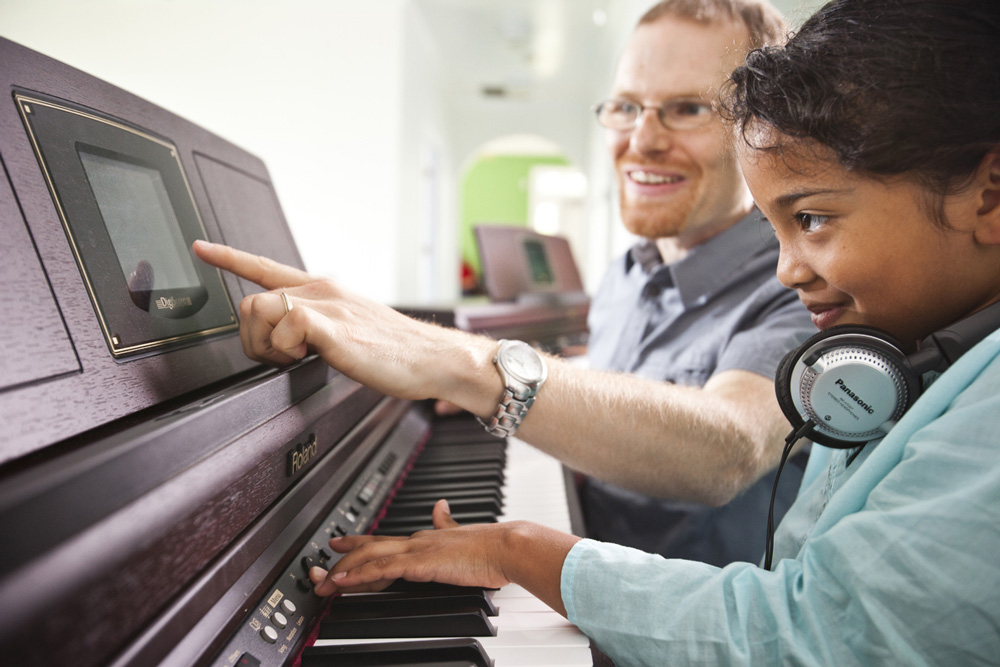
At The Piano Express, we specialize in fun, motivating piano classes and private lessons for pre-college students. We have studios in Ashburn and Sterling, and we’re often asked about the kind of piano a parent should I buy for their child. Since so many of our students love to practice, having the right instrument at home makes a real difference.
This guide walks you through what features matter most and offers real, up-to-date recommendations. If you haven’t started lessons yet, we also invite you to schedule a free first lesson at either of our Northern Virginia locations. Get in touch for piano lessons in Sterling, lessons in Ashburn, or if you live in nearby Herndon and would like to get started.
What Should a Student Piano Include?
Why Weighted Keys Are So Important
Students who learn on weighted keys build better control, stronger fingers, and more accurate technique. Most quality digital pianos use graded hammer action, meaning the lower keys feel heavier and the upper keys feel lighter, just like an acoustic piano. This helps kids develop habits they can carry with them to recitals, group class, or more advanced study.
The Full 88-Key Layout
Pianos have 88 keys for a reason. While many starter keyboards only have 61 or 76 keys, these will become limiting quickly. Intermediate pieces often use notes across the full range, and a smaller keyboard can disrupt hand positioning and awareness. We strongly recommend 88 keys if you’re planning to stick with lessons even for a few months.
Tone Quality, Pedals, and Cabinet Design
Choose an instrument with a warm, realistic tone. Even beginners can tell the difference between flat, synthetic sound and a piano voice that feels expressive. A proper music stand, full-height cabinet, and comfortable bench position also make practice more productive. And when your child starts using pedal techniques, you’ll want at least a working damper pedal with some resistance.
Should You Buy a Piano for the Long Term?
Some families look for an inexpensive keyboard to test the waters, but in our experience, this often backfires. A flimsy or unresponsive instrument may actually discourage your child. Since our teaching style makes lessons fun and progress exciting, we’ve found that students genuinely want to play, so giving them a piano that feels good to play can make a big difference.
If piano is going to be part of your household for years to come, it’s worth considering a higher-end acoustic upright or a digital hybrid. If you’re still figuring out long-term goals, a high-quality digital piano with good action and sound can serve your child well for the first few years.
Recommended Digital Pianos for Kids Taking Lessons
Yamaha P-145 and P-225
The Yamaha P-145 ($499) is a compact, no-frills digital piano with 88 weighted keys and solid Yamaha tone. It’s ideal for beginners who want a clean interface and a reliable feel. The upgraded P-225 ($749 with matching stand and pedal unit) includes better speakers, a sleeker design, and more expressive tone. Both models use Yamaha’s Graded Hammer Compact action and work well with headphones for quiet practice.
Roland FP-10 and FP-30X
Roland’s FP-10 ($599) is a favorite among teachers for its responsive PHA-4 key action and full 88-key range. It’s a bit deeper than the Yamaha in terms of tone color and allows for Bluetooth MIDI connectivity. The FP-30X ($799) steps it up with upgraded sound, louder onboard speakers, and extra layering features. Both offer a solid playing experience for kids who want a piano that feels authentic under the fingers.
Casio Privia PX-870
The PX-870 ($1,199) is a full-cabinet digital piano that looks like a real upright and sounds remarkably good for the price. It features Casio’s Tri-Sensor Scaled Hammer Action II and comes with built-in pedals, a sturdy cabinet, and a sound engine that captures nuance and dynamics well. It’s a great mid-range choice for parents who want a quality setup in the living room or dedicated practice space.
What Is a Digital Hybrid Piano?
Many people confuse high-end digitals with digital hybrids. A true hybrid instrument blends digital sound technology with physical piano components, such as wooden keys, real hammers, and authentic key mechanisms. These are designed to replicate the action of an acoustic piano with striking realism, without the need for tuning or as much space.
Yamaha AvantGrand Series
The Yamaha AvantGrand line starts with the N1X (around $8,000) and includes models like the NU1XA and N3X. These instruments feature a real acoustic piano action inside a digital body. The result is incredible touch and control, paired with high-resolution sampling and a minimalist, modern look.
Kawai Novus Series
The Kawai NV5S and NV10S (starting at $9,000) use Kawai’s Millennium III upright and grand actions, respectively. The keys and hammers feel nearly identical to Kawai’s acoustic pianos, while the sound is produced digitally with precise speaker placement. These are top-tier options for families who want long-term value without committing to a traditional acoustic.
Acoustic Upright Pianos That Work Well for Kids
Yamaha U and B Series
The Yamaha U1 (used $4,000 to $6,000) is a gold standard among upright pianos. It offers excellent tone, reliability, and action feel, all in a reasonably sized cabinet. For families on a tighter budget, the B1 and B3 models offer a great introduction to acoustic piano ownership, often found new for $4,000 or less.
Kawai Uprights
Kawai’s K series, including the K-200 and K-300, is known for its smooth action and mellow tone. They’re often priced slightly below Yamaha’s equivalents and are a favorite among teachers who want a slightly lighter touch for younger students.
Boston and Essex
Designed by Steinway and built by Kawai and Pearl River, respectively, these pianos offer refined tone and build quality without reaching Steinway’s full price tag. Boston uprights typically range from $8,000 to $11,000 new, while Essex uprights are often in the $5,000 to $7,000 range.
Steinway Uprights and Grands
There’s no denying the craftsmanship and tone of a Steinway upright or grand. That said, these instruments can be quite powerful in volume, and their action may feel a bit firm for younger fingers. If you inherit or purchase a Steinway, it’s worth having a technician evaluate the touch weight and voicing to suit your child’s level.
Have Questions? Let’s Talk Pianos.
We believe that students succeed when lessons are fun and progress is clear. Having a piano at home that responds well and sounds great can dramatically improve practice and motivation.
If you’re still deciding what kind of piano makes sense for your family, our team at The Piano Express is happy to help. And if you’re just getting started with lessons, take advantage of our free first lesson offer at either our Ashburn or Sterling studio.
A well-chosen instrument makes practice more enjoyable and lessons more productive. With the options available today, there’s never been a better time to bring music into your home.
Recent Comments